




Time:2026-01-30 Views:1
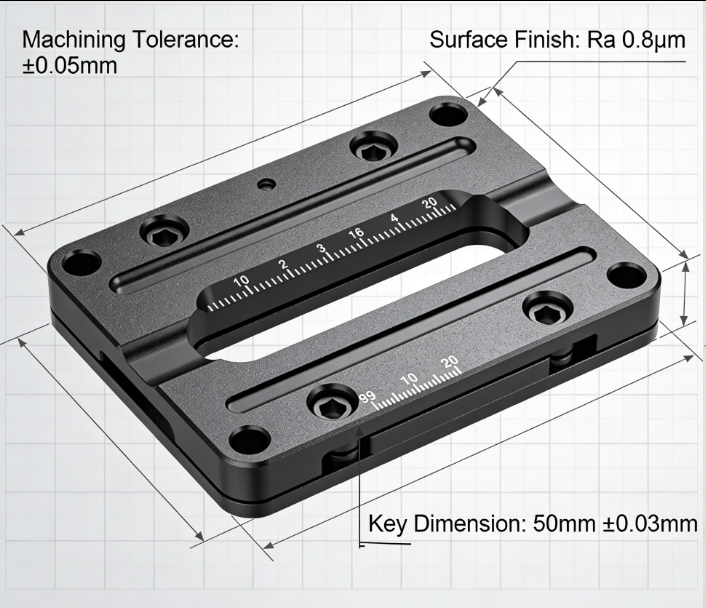
Machining accuracy is a critical factor in the performance of quick-release plates, as even minor deviations from design specifications can compromise the fit, functionality, and safety of the component. High precision ensures that the plate engages and disengages smoothly, maintains proper alignment with mating parts, and withstands operational stresses without loosening or failing.
Tolerances for quick-release plates are typically tight, with dimensional allowances ranging from ±0.01 mm to ±0.1 mm depending on the application. For example, the diameter of a spring-loaded pin in a locking mechanism may require a tolerance of ±0.02 mm to ensure it slides freely in its housing while maintaining a secure fit. Similarly, the spacing between mounting holes must be precise to ensure compatibility with standardized components—critical in applications like camera equipment, where a mismatch can lead to instability or damage.
Achieving such accuracy requires advanced machining equipment and techniques. CNC (Computer Numerical Control) milling and turning centers are the workhorses of precision quick-release plate production, offering high repeatability and control over cutting tools. These machines are programmed with CAD/CAM software, which converts design specifications into precise toolpaths, minimizing human error. High-speed spindles and precision tooling (e.g., carbide end mills) further enhance accuracy by reducing vibration and ensuring clean, consistent cuts.
Material properties influence machining accuracy, as some materials are more challenging to machine than others. Metals like aluminum and brass are relatively easy to machine with high precision, while harder materials like stainless steel or titanium require specialized tools and cutting parameters to avoid tool wear and maintain tight tolerances. Plastics, though less rigid, can present challenges due to their tendency to warp during machining, requiring careful fixturing and coolant usage to prevent deformation.
Fixturing is another key aspect of ensuring machining accuracy. Quick-release plates must be securely held in place during machining to prevent movement, which can cause dimensional errors. Custom fixtures or vises with soft jaws (made of materials like aluminum or brass) are often used to grip the plate without damaging its surface, ensuring consistent positioning across multiple parts. For complex geometries, 3D-printed fixtures tailored to the plate’s shape can provide optimal support, improving accuracy and reducing setup time.
Measurement and inspection are integral to maintaining machining accuracy. Coordinate Measuring Machines (CMMs) are used to verify critical dimensions, comparing the machined plate to the CAD model and generating detailed reports on deviations. Optical comparators and laser scanners are employed for high-speed inspection of surface features and contours, ensuring that locking mechanisms, mounting holes, and other functional elements meet design requirements. Statistical process control (SPC) is also used, with operators regularly sampling parts to monitor for trends in dimensional variation, allowing for adjustments to the machining process before out-of-tolerance parts are produced.
Environmental factors can affect machining accuracy, so precision machining facilities are often climate-controlled to maintain stable temperatures (typically 20°C ± 1°C). Temperature fluctuations can cause materials and machine components to expand or contract, leading to dimensional errors. Vibration isolation systems are also used to protect sensitive machining equipment from external vibrations, which can disrupt cutting precision.
The impact of machining accuracy on quick-release plate performance is significant. A plate with excessive tolerance variation may fail to lock securely, leading to accidental disengagement, or may require excessive force to operate, reducing user satisfaction. In high-load applications, dimensional inaccuracies can create stress concentrations, leading to premature failure. Conversely, tight machining accuracy ensures consistent performance, extended service life, and reliable operation across all intended use cases.
Read recommendations:
camera cage for photography Supply chain
fun in underwater photography Accessories
© 2024 Jiani Digital Technology Co., Ltd. All rights reserved Powered by Nbone


 Home >


