




Time:2026-01-24 Views:1
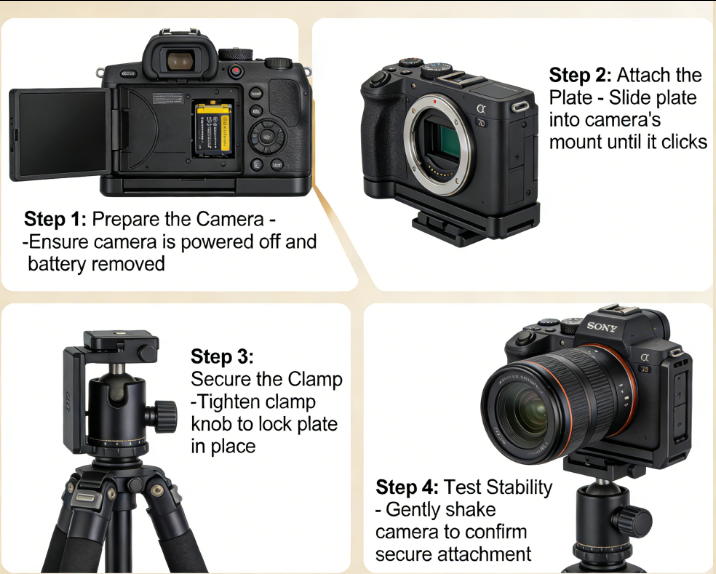
The installation of quick - release plates is a critical process that requires careful attention to detail to ensure proper functionality, stability, and safety of the overall system. Whether it is for photography equipment, industrial machinery, or other applications, a correct installation is essential for the quick - release plate to perform its intended role effectively.
The first step in installing a quick - release plate is to prepare the surfaces. Both the surface of the component to which the plate will be attached and the mating surface of the quick - release plate itself need to be clean and free of any debris, dust, or contaminants. This can be achieved by using a suitable cleaning agent and a lint - free cloth. In the case of metal surfaces, it may also be necessary to remove any rust or oxidation to ensure a good bond. For example, when installing a quick - release plate on a camera, the camera's base should be thoroughly cleaned to ensure that the plate attaches securely and does not cause any scratches or damage to the camera body.
Next, the positioning of the quick - release plate is crucial. It should be placed accurately on the target component according to the manufacturer's instructions or the specific requirements of the application. In some cases, there may be alignment marks or holes on both the plate and the component to assist with proper positioning. For instance, when installing a quick - release plate on a tripod head, the plate should be centered and aligned with the mounting holes on the tripod head to ensure a balanced and stable connection. Once the plate is in the correct position, it can be temporarily secured using alignment pins or by lightly tightening the initial fasteners to hold it in place while ensuring that it can still be adjusted if necessary.
The fastening process is the core of the installation. Depending on the type of fasteners used, specific tools and techniques are required. If screws are being used, a screwdriver or a power drill with the appropriate bit should be used. It is important to tighten the screws evenly and gradually to avoid warping the plate or damaging the component. Over - tightening can lead to stripping of the screw holes or deformation of the plate, while under - tightening may result in an insecure connection. For clips, latches, or other types of fasteners, the installation process may involve pressing, snapping, or rotating the fastener into place according to its design. After all the fasteners are tightened or engaged, a final check should be conducted to ensure that the quick - release plate is firmly attached and there is no movement or play.
In addition, for some quick - release plate systems, additional adjustments or calibrations may be necessary. For example, in a camera - tripod quick - release plate setup, the plate may need to be adjusted to ensure that the camera is level. This can be done using built - in leveling mechanisms or by making fine - tune adjustments to the position of the plate. In industrial applications, the quick - release plate may need to be calibrated to ensure proper alignment with other components in the machinery. Overall, the installation of quick - release plates demands careful planning, precise execution, and thorough testing to ensure a reliable and functional installation in any application.
Read recommendations:
© 2024 Jiani Digital Technology Co., Ltd. All rights reserved Powered by Nbone


 Home >


